For decision-makers
The policy ask is simple: protect the Seal River Watershed in full, make the mineral exploration moratorium permanent, and pair the IPCA with a federal–provincial Greenstone Parks framework for Manitoba's working mineral districts. Both halves of the compact, announced together, by the same ministers, on the same day.
For citizens
Support the Seal River proposal. Submit before June 2 telling governments to protect the whole watershed and strengthen mining policy where mining actually belongs. A short submission in your own words is enough — what matters is volume and substance.
The framework at a glance
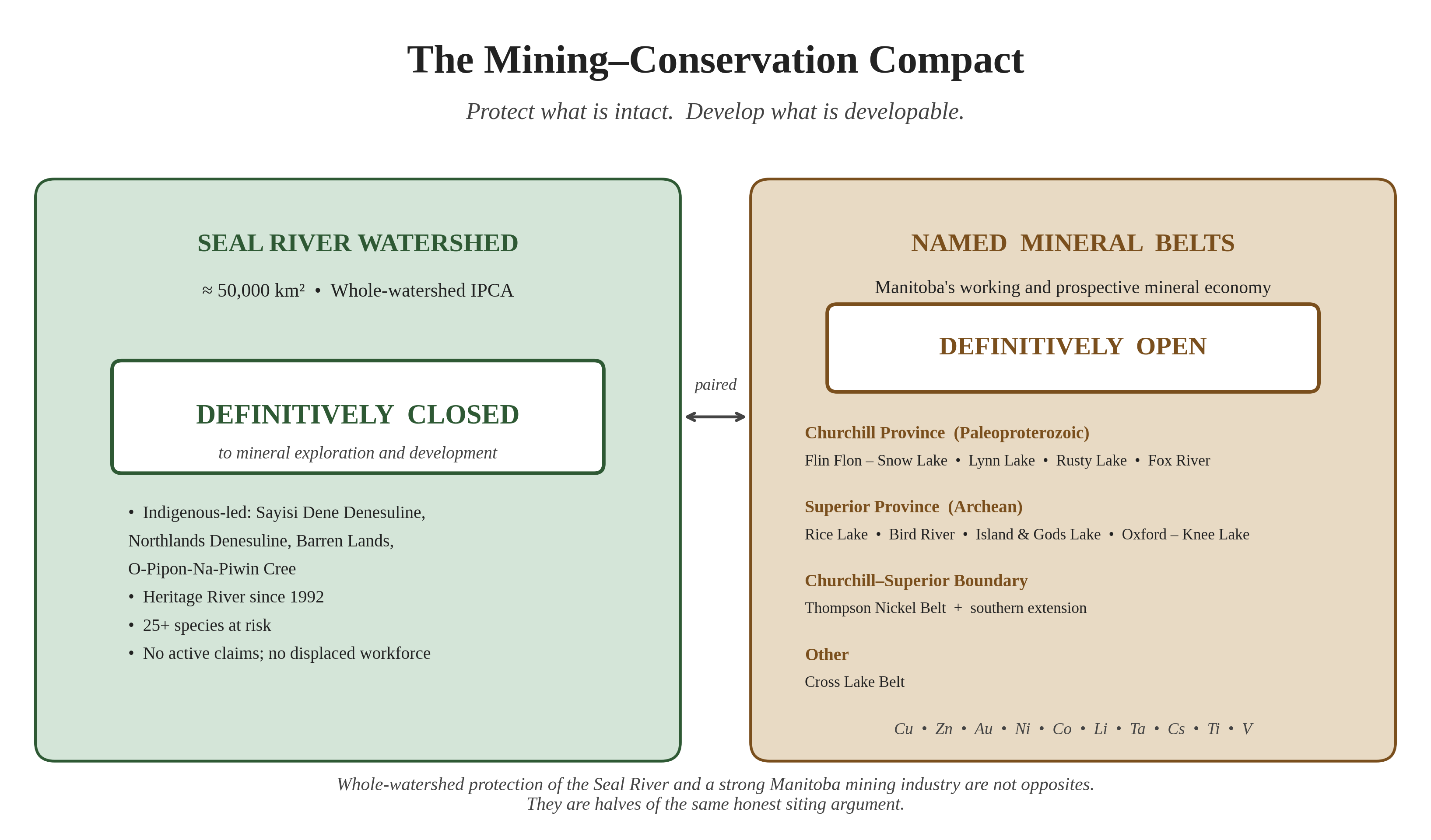
The Mining–Conservation Compact
Mining and conservation are not opposites. They are halves of the same honest siting argument. Protect what is intact, develop what is developable — and make both halves of the trade public.
Manitoba's Greenstone Parks
A proposed designation for Manitoba's working and prospective mineral belts — parallel in political weight, public branding, and statutory permanence to Indigenous Protected and Conserved Areas. The policy companion to the IPCA.
The Seal River Watershed
The 50,000-square-kilometre Indigenous-led conservation proposal currently in front of the public. Public consultation is open until June 2, 2026. The case study the framework was built around.
Critical Minerals
"Down to rare earth: Canada ignores China's resource power grab at its own peril." My November 2020 Globe and Mail piece on the Tanco Mine and Canada's strategic exposure on cesium, tantalum, and lithium. The argument that informs the Greenstone Parks framework today.
Recent writing
The Watershed I Can't Paddle — a five-part essay series, April–June 2026, at stevenjohnfletcher.substack.com.
Eight Years Later — What Actually Happened
May 2026
When I rose in the Manitoba Legislature in November 2017, the Seal River Watershed Alliance did not exist yet. The federal government had no plan to protect anything. Eight and a half years later, this is where we are.
Naturalist, Engineer, Politician, Canoeist
May 2026
A year after the speech in the Manitoba Legislature, I described myself in print with four words I do not usually put together in one place. I picked them on purpose.
The Speech Nobody Listened To
May 2026
The federal government had announced a 4,400-square-kilometre national park. They had announced it on top of a working nickel mine. They hadn't asked anyone.
About this site
I am the Honourable Steven Fletcher, P.C., P.Eng. I served as Member of Parliament for Charleswood–St. James–Assiniboia from 2004 to 2015, including in Cabinet under Prime Minister Stephen Harper, and as Member of the Legislative Assembly of Manitoba from 2016 to 2019. I am a geological engineer by training and a wilderness paddler by formation, and I have spent nine years arguing — in legislative chambers, in print, and online — for a thoughtful Canadian approach to mineral development that takes both the resource economy and the environment seriously.
Mindful Mining is not a slogan. It is a policy posture: honest siting, durable frameworks, Indigenous partnership, and a clear public statement of where Canada protects and where Canada develops. This site is where that argument lives. The Substack is where I write about it. The submission to the Seal River consultation is where it meets the policy moment.