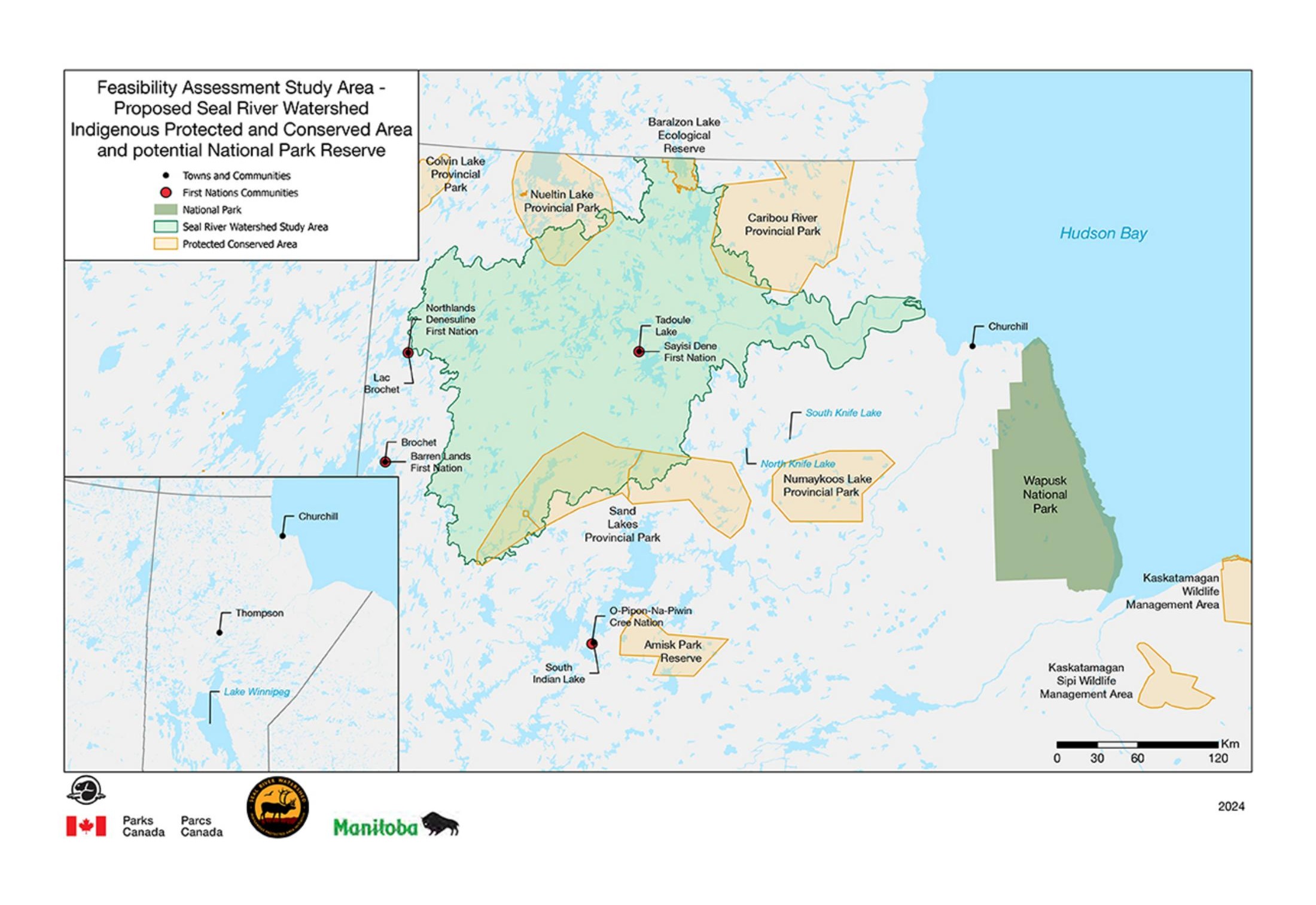
The watershed at a glance
The Seal River flows 260 kilometres from its headwaters to Hudson Bay, undammed and unindustrialized. Its watershed holds polar bears, beluga whales, caribou, lake trout, and one of the largest concentrations of boreal woodland caribou in the country. It is a Canadian Heritage River, designated in 1987.
What makes the watershed unusual is not any single species or feature. It is that the entire system — headwaters, tributaries, mainstem, estuary — still functions as a complete unit. Most of the world's large watersheds have been broken into managed fragments. This one has not.
No operating mines. No active mineral claims under exploration. No roads through the interior. No displaced workforce, no stranded capital, and no industrial footprint to compensate. The protection is honestly sited.
The story so far
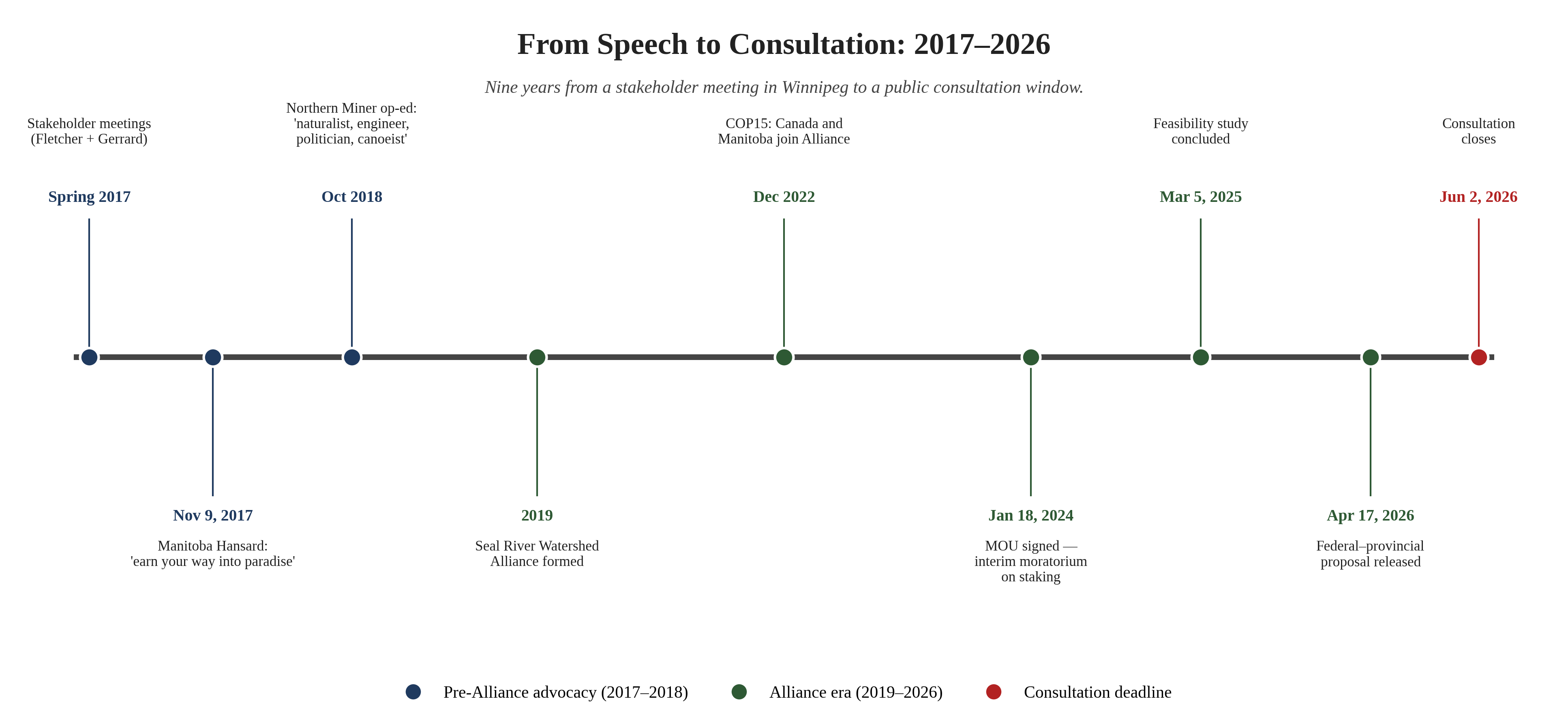
In April 2017, the federal government announced a different national park, between Lake Winnipeg and Lake Winnipegosis — a proposal that sat directly on top of the southern extension of the Thompson Nickel Belt, Manitoba's third-largest industry. On November 9, 2017, I rose in the Manitoba Legislature and proposed something different: protect the Seal River Watershed instead. No orebody. Four First Nations whose ancestral territory it has always been, already working on protection. A complete watershed that could be protected without displacing anyone or stranding any capital.
It took eight and a half years. The Seal River Watershed Alliance formed and grew. The federal government committed $74.7 million to the Indigenous-led conservation framework. The provincial government issued a mineral-exploration moratorium in 2024. Manitoba elected a new government in 2023 that has continued to support the protection. Parks Canada completed the feasibility assessment in 2025. The four First Nations of the Alliance, the federal government, and the Government of Manitoba reached the agreement that is now in public consultation. The reason Manitoba has the option to protect the Seal River today is that Manitoba did not protect the Lowlands in 2017.
What's on the table
The proposal would establish the Seal River Watershed as an Indigenous Protected and Conserved Area covering the full fifty-thousand-square-kilometre watershed. The four First Nations of the Alliance hold primary stewardship under their own laws and governance. The federal and provincial governments are partners — committed funders and policy-makers — rather than the lead authority. This structure reflects the form of conservation that the United Nations Declaration on the Rights of Indigenous Peoples points toward in the twenty-first century.
The 2024 mineral exploration moratorium would be made permanent. Recreational use — hunting, fishing, paddling, hiking — continues, governed by rules set by the Alliance. A joint management board, with consensus-based decision-making, oversees implementation. The federal commitment of $74.7 million anchors the funding side. The full protection structure, with all twenty-six recommendations I would add to it, is in the formal submission below.
My submission to the consultation
On May 5, 2026, I filed a forty-four-page formal submission to the public consultation, supporting the establishment of the Seal River IPCA in its full hydrological extent and making twenty-six specific recommendations across seven themes. The submission is also where the mining–conservation compact framing — and the proposal to pair the Seal River announcement with a parallel public designation of Manitoba's working mineral districts, Manitoba's Greenstone Parks — appears in policy form.
Download the formal submission (PDF, 44 pages)
Three of the twenty-six recommendations the submission makes:
- Lock the IPCA boundary to the full hydrological watershed of the Seal River. No carve-outs, no boundary adjustments at the negotiation stage.
- Convert the 2024 mineral exploration moratorium into a permanent prohibition, alterable only by fresh legislation — not by ministerial discretion.
- Issue a contemporaneous federal–provincial joint statement naming Manitoba's Greenstone Parks as the parallel designation framework for the working mineral districts. Both designations announced together.
The Watershed I Can't Paddle — a five-part Substack series
A personal essay series running April through June 2026, on Substack. The five posts build the full case the formal submission makes — but written for a general audience.
The Speech Nobody Listened To
May 2026
The November 9, 2017 Hansard speech in context.
Naturalist, Engineer, Politician, Canoeist
May 2026
The four lenses that made the case.
Eight Years Later, What Actually Happened
May 2026
The Alliance, COP15, the agreements, the April 17, 2026 announcement.
The Watershed Is Yours Now
Coming late May 2026
What's still at stake, what you can do, the hand-off.
What you can do, before June 2
Submit to the consultation
The EngageMB.ca portal accepts public submissions until midnight, June 2, 2026. The portal asks for your support or concerns and includes a comment box. You can submit in your own words, or use the framing from my submission as a starting point.
Write to your representatives
A letter to your federal MP, your provincial MLA, or to Premier Kinew and Prime Minister Carney carries weight in any consultation, especially one whose outcome will be set by federal–provincial agreement. Even a short note in your own words is useful.