The argument
Mining and conservation are not opposites. They are halves of the same honest siting argument. The right place to protect is the place that is genuinely intact — no roads, no operating mines, no industrial footprint, no displaced workforce. The right place to mine is the place where the geology is real, the workforce is established, the infrastructure is in place, and the Indigenous communities of the region have built partnerships with the resource economy. Both halves of that distinction deserve public, durable, statutory recognition. The job of policy is to make the trade visible — and then defend both halves of it.
Why honest siting
In April 2017, the federal government announced a national park between Lake Winnipeg and Lake Winnipegosis. The map looked clean. The reality was not. The proposed park sat directly on top of the southern extension of the Thompson Nickel Belt — Manitoba's third-largest industry, a working mining region whose royalties, tax revenue, and Indigenous-partnership jobs run northern Manitoba's economy. Putting a national park on top of an active orebody is a particular kind of policy mistake. It does not protect anything that is rare. It freezes development in a place where development was already happening — and was needed — for the people who live there.
In November 2017, I rose in the Manitoba Legislature and proposed a different park, in a different place, for different reasons. The Seal River Watershed — fifty thousand square kilometres of intact boreal forest and tundra in northern Manitoba, almost entirely free of roads, mines, or industrial development. No active mining claims. A complete watershed, headwaters to Hudson Bay, still functioning as a single ecological system. That is the right place to protect. That is the place where conservation does not have to displace anyone or strand any capital, because no one and nothing has been there in the modern industrial sense.
The 2017 case I made was not against parks. It was for parks in the right places. Almost a decade later, with the Seal River consultation in front of the public and the Manitoba mineral economy hungrier than ever for predictability, the same argument applies — only now the policy moment is finally caught up to it.
What "balance" actually means
Some critics of the Seal River proposal have framed their concerns under the banner of "balance." There are two versions of that argument and they should not be confused. The legitimate version is about access — will Manitobans continue to be able to hunt, fish, paddle, and visit the watershed? The Alliance has answered yes. The proposal has answered yes. On that question, the framing is unnecessary, because the answer is already on the page.
The illegitimate version is about leaving portions of the watershed open to mineral exploration so that Manitoba does not "give up" potential mining revenue. That is a different question, and dressing it as "balance" obscures it. The watershed has uranium deposits in the west, diamonds in the east, and gold in the south-central portions. None are currently being developed, and none can be developed without doing meaningful damage to the very ecological values the proposal exists to protect. The right response to that argument is not to relitigate the boundary. It is to point out that the trade is already available — somewhere else. The "balance" Manitoba should be looking for is across the province, not inside the watershed.
The compact on the table
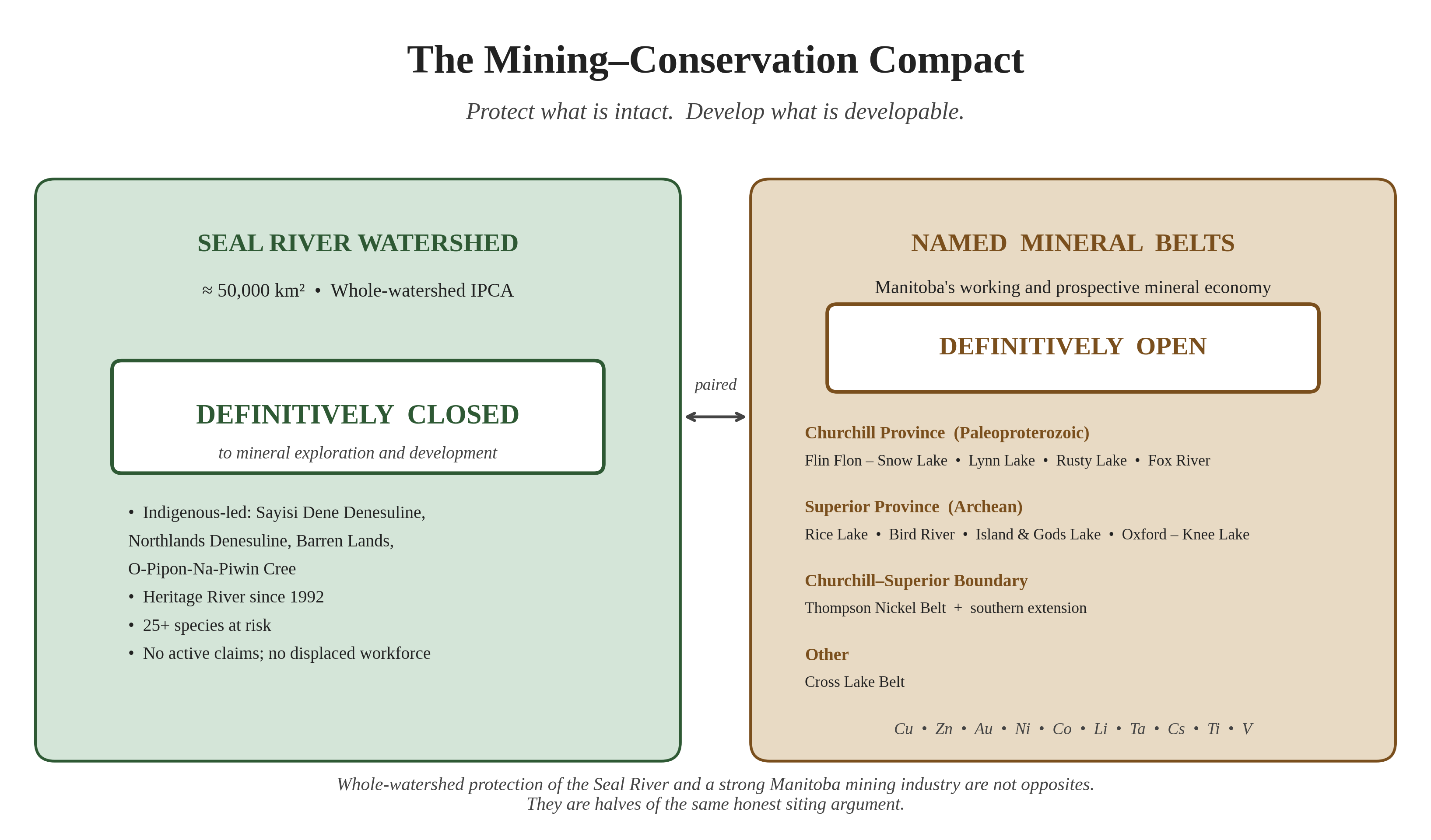
The version of the Seal River proposal that survives the consultation should be paired with a public federal–provincial statement that does three things. First, it should name the Seal River Watershed as definitively closed to mineral development. Second, it should name Manitoba's working mineral districts — the Thompson Nickel Belt and its southern extension, the Flin Flon – Snow Lake Belt, the Bird River Belt, the Lynn Lake gold district, and the rest of the geological framework laid out on the Greenstone Parks page — as definitively open and supported. Third, it should commit to the policy alignment, infrastructure investment, and federal–provincial coordination that makes the second half of that distinction real.
Both halves of the announcement should be made by the same ministers, in the same legislative chambers, on the same day. Manitoba's signature land-use policy of this generation should not be the IPCA alone; it should be the IPCA paired with the Greenstone Parks. Conservation where it belongs. Mining where it belongs. Both designated. Both branded. Both durable.
Without the pairing, the protection is politically unstable. The "balance" critique resurfaces every cycle, capital reads the conservation announcement as a one-way move, and the durable protection erodes at the edges in negotiation. With the pairing, the public and the industry both see the trade clearly and accept it. Capital responds to durability. The protection becomes more, not less, secure once the working mineral districts have a designation of equal weight.
Read the Greenstone Parks proposal
The policy operationalization of the compact. Manitoba's mineral belts, the fast-track-with-environmental-assessment-integrity model, Indigenous co-design.
Read the Seal River submission
The current case study. Twenty-six recommendations, in front of the federal and provincial governments and the four First Nations of the Alliance.